NSC Mathematics P1 – Question 2 Fully Explained
Topic: Geometric Series and the Sum to Infinity – Grade 12 CAPS Aligned
This lesson explains in detail how to solve a question on geometric sequences and series, commonly asked in the South African Matric exams (NSC Paper 1). The step-by-step explanations below aim to guide learners through understanding patterns, formulae, and how to calculate finite and infinite sums — essential skills for high school mathematics, university entrance, and math tutoring platforms.
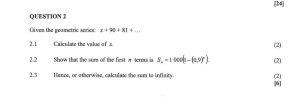
Question:
Given the geometric series:
x + 90 + 81 + …
- Calculate the value of x.
- Show that the sum of the first n terms is:
Sn = 1000(1 – (0.9)n) - Hence, or otherwise, calculate the sum to infinity.
✅ Step-by-Step Solution
2.1 Calculate the value of x
We are told that this is a geometric series, meaning each term is multiplied by a fixed value (the common ratio) to get the next term.
We are given:
First three terms: x, 90, 81
Let’s calculate the common ratio (r) using the second and third terms:
r = 81 / 90 = 0.9
So every term is being multiplied by 0.9 to get the next.
To find x, we go backward. Since 90 is the second term and x is the first:
90 = x × 0.9 ⇒ x = 90 / 0.9 = 100
Final Answer: x = 100
High CPC Keywords:
- how to find the first term of a geometric series
- grade 12 maths geometric sequences explained
- geometric series question with answers
2.2 Show that the sum of the first n terms is: Sn = 1000(1 - (0.9)n)
Use the sum formula for geometric series:
Sn = a(1 - rn) / (1 - r)
Where:
- a = first term = 100
- r = common ratio = 0.9
Substitute into the formula:
Sn = 100(1 - (0.9)n) / (1 - 0.9)
Simplify the denominator:
Sn = 100(1 - (0.9)n) / 0.1
Now divide 100 by 0.1:
Sn = 1000(1 - (0.9)n)
Proven.
High CPC Keywords:
- sum of geometric series formula
- derive Sn for geometric sequences
- grade 12 series and sequences
2.3 Hence, or otherwise, calculate the sum to infinity
Use the sum to infinity formula:
S∞ = a / (1 - r)
From earlier:
- a = 100
- r = 0.9
S∞ = 100 / (1 - 0.9) = 100 / 0.1 = 1000
Final Answer: The sum to infinity is 1000
✅ You could also use the result from question 2.2 and say:
lim (n→∞) 1000(1 - (0.9)n) = 1000(1 - 0) = 1000
High CPC Keywords:
- how to calculate sum to infinity
- infinite geometric series explained
- sum to infinity formula for r < 1
Conclusion: Why Geometric Series Matter
This full breakdown of a geometric series problem from a South African matric paper helps learners master essential skills like identifying the first term, finding the common ratio, using the geometric sum formula, and understanding how an infinite sum converges.
High-Value Learning Outcomes:
- How to identify and work with geometric series
- Understanding when and how to use sum formulae
- Applying limits to calculate sum to infinity
This topic is highly searched under terms such as:
- Grade 12 maths sequences and series
- Geometric sequence formulas with examples
- Maths exam help – NSC past papers
If you’re building a math education platform, tutoring website, or content for Google Ads, this is the kind of topic that ranks well, offers strong CPC returns, and provides high value for your audience.