Grade 11 Mathemetics Term Common Test
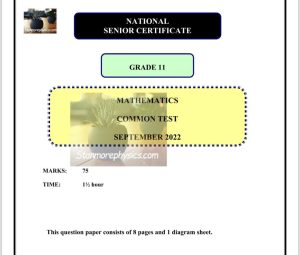
Maths-Grade-11-SEPT-2022-QP-and-Memo (1)
How to Pass Grade 11 Maths: Probability, Statistics, and Graphs
Mathematics in Grade 11 can be challenging, especially topics like Probability, Statistics, and Graphs. These sections require understanding formulas, analyzing data, and interpreting graphs correctly. Many students struggle because they memorize without understanding. This guide will help you pass and excel in these topics.
Understanding Probability
Probability measures how likely an event is to occur. It’s used in everyday life, from predicting the weather to games of chance.
Key Probability Concepts
- Experiment: Any action that produces outcomes. Example: tossing a coin.
- Outcome: A possible result. Example: getting heads when tossing a coin.
- Event: A set of outcomes. Example: rolling an even number on a dice.
Probability Formula
The probability of an event E occurring is:
\( P(E) = \frac{\text{Number of favorable outcomes}}{\text{Total number of outcomes}} \)
Example: Probability of rolling a 3 on a 6-sided dice:
\( P(3) = \frac{1}{6} \)
Types of Probability
- Theoretical Probability: Based on reasoning, assuming all outcomes are equally likely.
- Experimental Probability: Based on experiments or observations.
- Compound Probability: Probability of two or more events happening together.
Tips for Probability
- Master formulas for single, combined, and complementary events.
- Use diagrams like Venn diagrams or probability trees.
- Practice translating word problems into formulas.
- Check answers: probability always lies between 0 and 1.
Statistics: Collecting, Representing, and Interpreting Data
Statistics involves organizing and analyzing data to make informed decisions. You will encounter mean, median, mode, range, and data representation using tables, charts, and graphs.
Key Statistics Formulas
Mean (Average)
For a dataset with n observations \(x_1, x_2, \dots, x_n\):
\( \text{Mean} = \frac{x_1 + x_2 + \dots + x_n}{n} \)
Median
If n is odd:
\( \text{Median} = x_{\frac{n+1}{2}} \)
If n is even:
\( \text{Median} = \frac{x_{\frac{n}{2}} + x_{\frac{n}{2}+1}}{2} \)
Mode
The mode is the value that occurs most frequently.
Range
\( \text{Range} = \text{Maximum value} – \text{Minimum value} \)
Representing Data
- Tables: Frequency tables or grouped tables summarize large datasets.
- Graphs: Bar graphs, histograms, pie charts, and line graphs help visualize data.
Tips for Statistics Success
- Always label axes in graphs and include units.
- Use consistent scales to avoid misinterpretation.
- Practice interpreting data trends and identifying highest/lowest values.
- Recalculate mean, median, and mode to avoid errors.
Graphs: Understanding and Drawing
Graphs visually represent data, making it easier to analyze trends and relationships. You’ll work with linear graphs, quadratic graphs, and graphs from tables.
Key Graph Concepts
- Plotting Points: Each point has coordinates \((x, y)\).
- Reading Graphs: Interpret values for given x or y coordinates.
- Slope of a Line (Gradient):
\( m = \frac{y_2 – y_1}{x_2 – x_1} \)
Equation of a Line
\( y = mx + c \)
Where \(m\) = slope and \(c\) = y-intercept
Tips for Graphs
- Use graph paper for accuracy.
- Label all axes and points.
- Check scales and intervals.
- Practice drawing and interpreting various graph types.
Combining Probability, Statistics, and Graphs
Exams often combine topics. Example: A table of exam scores may ask for the mean, median, mode, and probability of scoring above a certain mark. Another example: A line graph of rainfall may require trend analysis, range, and probability calculations.
Strategy for Combined Questions
- Read carefully and identify what is asked.
- Organize data in tables if necessary.
- Solve step by step.
- Double-check calculations and interpretations.
Study Tips for Passing Grade 11 Maths
- Understand, don’t memorize formulas. Focus on the reasoning behind them.
- Use past papers for practice, especially combined-topic questions.
- Create formula sheets and review daily.
- Practice translating word problems into formulas.
- Work on graph skills and plotting accuracy.
- Ask for help when concepts are unclear.
- Allocate time for each topic and review regularly.
- Check work in exams for small mistakes.
Recommended Resources
- Grade 11 Maths textbooks for examples and explanations.
- Online tutorials like Khan Academy or YouTube videos for South African learners.
- Practice worksheets with probability trees, statistical tables, and graph exercises.
- Past papers and exam guidelines.
Common Mistakes to Avoid
- Forgetting to label axes on graphs.
- Confusing mean, median, and mode.
- Incorrect probability calculations.
- Inconsistent graph scales.
- Rushing through word problems without translating them into numbers/formulas.
Exam Strategy
- Start with easy questions to gain confidence.
- Allocate time wisely to all sections.
- Show all workings for partial marks.
- Review answers before submitting.
Motivation and Mindset
Passing Grade 11 Maths requires practice, patience, and persistence. Mistakes are part of learning. Daily practice, even 30–60 minutes, is more effective than last-minute cramming. Confidence improves focus and performance in exams.
Conclusion
To pass Grade 11 Maths in Probability, Statistics, and Graphs:
- Understand core concepts.
- Practice problem-solving and graph interpretation.
- Use past papers and exam-style questions.
- Avoid common mistakes and check all work.
With consistent study, careful practice, and a positive mindset, you can master these topics and achieve excellent results.