Iran Supreme Leader Says Strait of Hormuz Will Remain Closed
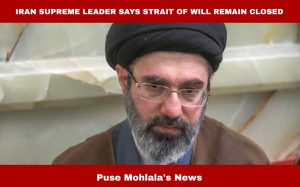
Iran Supreme Leader Says Strait of Hormuz Will Remain Closed: Global Trade and Energy Markets on Edge
Introduction
A major geopolitical shock is unfolding in the Middle East after Iran’s supreme leader declared that the Strait of Hormuz should remain closed, escalating tensions in one of the world’s most important maritime corridors. The narrow waterway, which connects the Persian Gulf to the Arabian Sea, is a strategic gateway for global energy trade and international shipping. The announcement has immediately raised concerns among governments, investors, financial institutions, and global logistics companies.
The decision has the potential to disrupt international supply chains, influence commodity markets, and reshape the balance of power in global energy markets. Oil traders, shipping companies, and multinational corporations are now assessing the possible economic fallout as uncertainty spreads through financial markets.
The Strait of Hormuz is widely considered the most critical energy chokepoint in the global economy. Roughly 20 million barrels of oil pass through the strait every day, representing about 20% of global petroleum consumption. The waterway also carries a significant share of the world’s liquefied natural gas shipments and supports a vast network of international maritime trade.
With the Iranian leadership signaling that the passage should remain closed as a strategic tool, analysts say the situation could trigger one of the most significant disruptions to global trade in decades.
Strategic Importance of the Strait of Hormuz
The Strait of Hormuz lies between Iran to the north and Oman and the United Arab Emirates to the south. At its narrowest point, the channel is only about 33 kilometers wide, yet it serves as the main export route for oil producers in the Persian Gulf.
Major energy exporters including Saudi Arabia, Kuwait, Iraq, Qatar, and the United Arab Emirates rely heavily on this route to transport crude oil and natural gas to international markets. Much of the energy flowing through the corridor is destined for fast-growing Asian economies such as China, India, Japan, and South Korea.
Because alternative routes are limited, the closure of this maritime passage could disrupt the flow of millions of barrels of oil per day. Experts warn that such a disruption could lead to a severe energy supply shortage and drive volatility across global commodity markets.
Beyond oil and gas, the waterway is also critical for the transportation of petrochemicals, refined fuels, and industrial materials used in manufacturing sectors around the world. From shipping logistics to energy infrastructure, the strait plays a central role in sustaining the global economy.
Iran’s Position and Political Message
Iran’s leadership has framed the closure as a strategic response to geopolitical tensions and military pressure from foreign powers. According to statements delivered through state media, the country views control of the waterway as a powerful lever in international negotiations.
Officials argue that the strait represents a vital security zone for Iran and that the country has the right to protect its national interests in the region. The decision to maintain the closure is widely interpreted as an attempt to pressure adversaries and reshape the strategic landscape of the Middle East.
The statement has also fueled uncertainty about how long the disruption might last. While some diplomatic voices have suggested that the closure could be temporary, others believe the standoff could persist if negotiations fail to produce a breakthrough.
The situation has created a complex geopolitical environment in which military strategy, economic leverage, and international diplomacy are tightly interconnected.
Immediate Reaction in Global Energy Markets
Financial markets reacted quickly to the announcement, with crude oil prices surging amid fears of supply disruptions. Energy traders across major exchanges began pricing in the possibility of reduced exports from the Gulf region.
Analysts warn that if the strait remains closed for an extended period, oil prices could rise significantly as global inventories tighten and supply chains become strained.
Higher oil prices could have ripple effects across numerous sectors, including transportation, manufacturing, agriculture, and aviation. For businesses already facing inflation pressures and volatile commodity markets, the crisis could intensify operational costs and reduce profit margins.
Energy-dependent economies may experience the most severe impact. Countries that rely heavily on imported fuel could see rising electricity costs, higher fuel prices, and increased pressure on national budgets.
Impact on Global Shipping and Logistics
The closure of the Strait of Hormuz is not only an energy issue—it is also a logistics crisis that could reshape international shipping routes.
Global shipping companies may be forced to reroute tankers and cargo vessels around alternative routes, increasing travel distances and raising freight costs. Maritime insurance premiums for vessels operating in the Persian Gulf have already begun to climb as insurers reassess risk levels.
Higher shipping costs are likely to affect international trade, particularly for industries that rely on just-in-time supply chains.
Container shipping, bulk cargo transportation, and petroleum logistics networks could all experience delays and operational disruptions.
For multinational corporations operating across global markets, the crisis could introduce new uncertainties into supply chain management, commodity sourcing, and production planning.
Inflation and the Global Cost-of-Living Crisis
One of the most immediate consequences of the crisis could be a renewed surge in global inflation.
Energy costs influence nearly every sector of the economy, from transportation and manufacturing to agriculture and consumer goods.
If fuel prices rise sharply due to reduced oil supply, businesses may pass the higher costs on to consumers. This could lead to increased prices for food, transportation, electricity, and household goods.
Central banks around the world are closely monitoring the situation because prolonged energy price spikes can complicate monetary policy decisions.
Higher inflation could force some governments to reconsider interest rate strategies and fiscal policies aimed at stabilizing their economies.
Effects on Global Financial Markets
The financial sector is particularly sensitive to geopolitical shocks affecting energy supply.
Stock markets often react quickly to uncertainty surrounding oil prices, trade routes, and geopolitical conflict.
Energy companies, commodity traders, and shipping firms may see dramatic fluctuations in share prices as investors attempt to evaluate the long-term impact of the crisis.
Meanwhile, safe-haven assets such as gold and government bonds may attract investors seeking stability during periods of market volatility.
Financial institutions and investment funds are also closely monitoring the risk exposure of companies involved in shipping, energy production, and global trade.
Energy Security Concerns
For many countries, the closure of the Strait of Hormuz raises serious concerns about energy security.
Governments may be forced to draw on strategic petroleum reserves or seek alternative suppliers to stabilize domestic fuel markets.
Some nations may accelerate efforts to diversify their energy sources, invest in renewable energy infrastructure, or expand domestic production capacity.
Energy diversification has become a key priority for many governments following previous global energy crises.
The current situation could further accelerate the transition toward alternative energy sources as countries seek to reduce dependence on vulnerable shipping routes.
Impact on Asian Economies
Asian economies are expected to be among the most heavily affected by any disruption in the strait.
A significant portion of the oil transported through the corridor is destined for Asia, making the region particularly vulnerable to supply interruptions.
Countries such as China, India, Japan, and South Korea rely heavily on Middle Eastern energy imports to power their industrial sectors and transportation systems.
If the disruption continues, these economies may face higher production costs, slower industrial growth, and increased inflation.
Energy shortages could also impact electricity generation, manufacturing output, and overall economic stability.
Global Diplomatic Efforts
The crisis has triggered urgent diplomatic discussions among major world powers.
International organizations, regional alliances, and global economic institutions are likely to play a role in efforts to stabilize the situation.
Negotiations aimed at reopening the strait could involve complex diplomatic arrangements addressing security concerns, sanctions, and regional power dynamics.
The outcome of these discussions will likely shape the future of energy markets and geopolitical stability in the Middle East.
Long-Term Economic Implications
If the Strait of Hormuz remains closed for an extended period, the consequences could extend far beyond short-term market volatility.
The crisis could accelerate structural changes in global trade patterns, energy supply chains, and international investment strategies.
Businesses may begin rethinking supply chain resilience, geographic diversification, and risk management strategies.
Energy companies may increase investment in alternative transport routes, pipeline infrastructure, and offshore production facilities.
Meanwhile, governments may strengthen policies aimed at protecting critical trade routes and securing energy supplies.
The Future of Global Trade Routes
The situation highlights the vulnerability of global trade networks to geopolitical tensions.
Maritime chokepoints such as the Strait of Hormuz play an outsized role in the functioning of the global economy.
Any disruption to these routes can have cascading effects across industries and regions.
The current crisis may prompt policymakers to explore new strategies for protecting critical shipping corridors and strengthening international maritime security.
Conclusion
The declaration by Iran’s supreme leader that the Strait of Hormuz should remain closed has introduced a new phase of uncertainty into global geopolitics and economic stability.
As one of the world’s most critical energy corridors, the strait sits at the heart of international trade, energy supply chains, and global financial markets.
The coming weeks will determine whether diplomatic negotiations can ease tensions and restore normal shipping operations.
Until then, governments, corporations, investors, and consumers around the world will continue watching the situation closely as the global economy navigates one of its most sensitive strategic chokepoints.